The Vacation Rental Scam Playbook: How to Spot Fake Listings Before You Wire Money
You found the perfect rental: a gorgeous beachfront villa in Greece, three bedrooms, sea view, private pool, $1,400 for the whole week. The host responded instantly, sent more photos, agreed to a small discount if you wired the deposit today. You sent the money.
The arrival date came. The address didn’t exist. The “host” disappeared. The villa was never theirs to rent. The photos were stolen from a real listing on a different platform two years ago. You just lost $1,400 to one of the most lucrative scam categories in modern travel — and you’re far from alone. The FTC reports U.S. consumers lost roughly $65 million to rental scams in the twelve months ending June 2025, and 2026 numbers are tracking higher.
Vacation rental scams work because they exploit a moment when travelers are excited, comparing fast, and willing to commit money to lock in a deal that “feels right.”
The good news: the patterns are repeatable, the red flags are visible, and a fifteen-minute verification routine catches almost every fake listing before you wire a dollar. This guide walks through the entire scam playbook — the listing creation, the off-platform pivot, the wire-transfer trap — and the practical defenses that work even when a listing looks pristine.
The Six Most Common Vacation Rental Scams in 2026
Scammers iterate. Six patterns currently dominate the vacation-rental fraud landscape, and most travelers see one or more of them in any active search.
1. The “phantom listing”
The property doesn’t exist. The photos are stolen from a real listing — sometimes a different city, sometimes a real estate sale page, sometimes a hotel website. The “host” responds quickly, has charming details, and pushes for a deposit before the platform’s verification kicks in. By the time you arrive, the entire listing is gone.
2. The double-booked bait-and-switch
The property exists, but it’s listed multiple times by the same scammer (or a network) at different prices. The scammer takes the highest-paying reservation, then cancels lower-paying guests “due to maintenance issues” or claims the address has changed — usually to a much worse property. A federal case in 2026 documented two cousins who ran a $1.5 million bait-and-switch network across roughly 100 properties on Airbnb and Vrbo using exactly this pattern.
3. The off-platform pivot
The scam starts on Airbnb or Vrbo. The “host” then offers a discount or a “private booking” if you message and pay outside the platform — Zelle, Venmo, wire transfer. Once you’re off-platform, the platform’s protections evaporate. You’re now in a private peer-to-peer transaction with no recourse.
4. The cloned listing on a third-party site
A scammer copies a real Airbnb or Vrbo listing — photos, description, address — and re-posts it on Craigslist, Facebook Marketplace, or a fake “vacation rental” website. They pose as the owner, take your deposit, and disappear. The real owner has no idea their property is being sold by a stranger.
5. The “owner asks for cash on arrival” twist
You book legitimately. On arrival, the “owner” claims the platform “delays payouts” or “double-charged them” and asks for an additional cash payment to release the keys. It’s pure extortion; the platform already paid them or will, and the cash demand is theft.
6. The host-side guest scam (rare, but real)
Less common but worth mentioning: travelers can occasionally be victimized by hosts who fabricate damage claims after checkout, requesting hundreds or thousands in “repairs.” Defensive habit: photograph and timestamp every room on arrival and again at checkout.
The Off-Platform Trap: Why Scammers Always Try to Move You
The single highest-frequency tactic across vacation-rental scams is the off-platform pivot. The reason is simple: the major platforms (Airbnb, Vrbo, Booking.com) build fraud-protection programs around money flowing through their payment systems. Pay through the platform, communicate through the platform, and the platform has both the data and the policy to make you whole if something goes wrong.
Step off the platform — direct wire, Zelle, Venmo, cryptocurrency, even a check — and you’re in a private transaction with no protection. The scammer’s first job is to get you off the platform with any plausible excuse:
- “The platform charges a 15% fee — I’ll knock 10% off if we book direct.”
- “My account is being verified, can you Zelle the deposit and I’ll mark it paid?”
- “For longer stays I prefer wire transfer — it’s how I do all my international bookings.”
- “Just send the deposit to my Cash App and I’ll send you the address.”
All four are scam tells. The platforms’ fraud teams have publicly stated this in 2026: bookings, communication, and payment must all stay on the platform. The moment any of those moves elsewhere, the platform cannot recover your money. Every payment method scammers prefer — Zelle, Venmo, wire transfer, crypto, cash — is irreversible by design. That’s why they prefer them.
The 15-Minute Pre-Booking Verification Routine
Before you send any money, run this checklist. It takes about fifteen minutes and catches the vast majority of fake listings.
- Reverse-image search every photo. Save 3–4 of the listing’s photos to your phone. Open Google Images (or Google Lens), tap the camera icon, and upload each photo one at a time. If the same photo appears on a different listing in a different city, on a real estate sales page, or on a hotel website, it’s stolen. Walk away.
- Verify the address on Google Maps and Street View. Type the property’s street address into Maps. Confirm a real building exists. Drop into Street View and check that the building looks like the listing photos. Scammers often use real addresses that point to apartment buildings, parking lots, or empty fields.
- Compare against rental comps in the area. Search the platform for similar properties in the same city or neighborhood. If the listing is significantly cheaper than comparable rentals — say, 30%+ below the local average — that’s a red flag, not a deal.
- Check the host’s review history. Real hosts have multiple reviews from real guests over months or years. New hosts with no reviews and “verified” listings should be scrutinized harder. Long-time hosts with sudden listing changes (new properties, big price changes) deserve a second look.
- Read three negative reviews carefully. Sort the reviews by lowest rating and read the worst three. The pattern of complaints reveals more about the property than the glowing five-star ones. Look for “owner asked for additional cash,” “address didn’t match,” “different property than listed.”
- Demand a video walkthrough or video call. Real hosts will agree to a brief video call to confirm they exist and the property exists. Scammers will refuse, claim “tech issues,” or ghost the request.
- Confirm contact details on a separate channel. Real listings include phone numbers and email addresses you can verify independently. Search the host’s name, phone number, and email on Google. Repeat scammers often have other complaints that surface in search.
- Check the platform’s fraud guarantee for the country. Some platforms have weaker protections in certain countries or for certain rental categories. Vrbo’s fraud guidance and Airbnb’s host-cancellation protection differ — read the terms before booking.
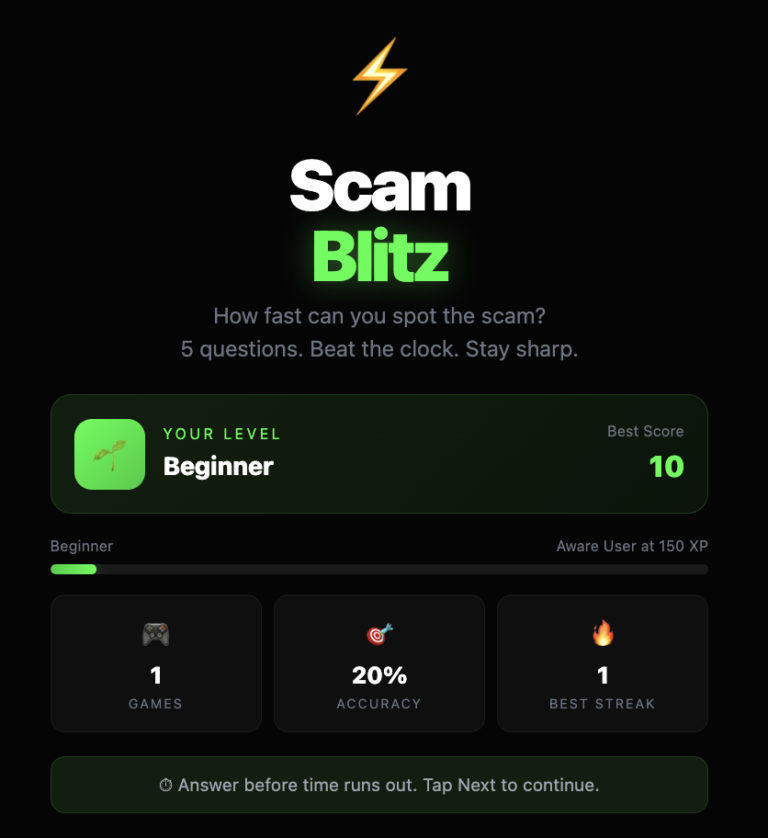
Beat the clock. Spot the scam.
Try Scam Blitz — 5 timed questions where every second counts. The faster you answer correctly, the bigger your combo. Real scam-spotting practice, gamified.
Start the blitz →How to Pay Safely (and What to Never Pay With)
The payment method matters as much as the platform. Here’s the hierarchy from safest to most dangerous.
Safest: A credit card paid through the platform. Credit cards add a second layer of protection — the chargeback right under the Fair Credit Billing Act. If the listing turns out fake or the host commits fraud, you can dispute the charge through your card issuer even if the platform’s resolution falls short. Always use a credit card, not a debit card, for any rental booking.
Acceptable: Platform-managed payment with debit card. If you must use debit, at least keep the transaction inside the platform’s payment system, where some protections exist. Direct debit is significantly weaker than credit card protection.
Dangerous: Zelle, Venmo, Cash App, PayPal “Friends & Family,” Apple Pay sent directly. These are peer-to-peer transfers designed for splitting the lunch bill, not for $2,000 vacation rentals. The FTC explicitly warns: anyone insisting on these methods for a rental is almost certainly running a scam. Once sent, the money is irretrievable.
Disqualifying: Wire transfer, cryptocurrency, gift cards, money orders. No legitimate rental platform requires these. Anyone who insists on them is a scammer. Period. The FTC’s guidance is unambiguous: never wire money for a vacation rental.
What to Do If You’ve Already Sent Money to a Scammer
If you suspect you’ve been scammed, the response window is narrow but real. The faster you act, the higher the chance of recovery.
Within 24 hours: Contact your bank’s fraud line and report the transfer. Banks have limited but real recovery tools for fraudulent wires and Zelle transfers if reported within hours. File a Zelle dispute through your bank’s app immediately.
Within 48 hours: File reports with the platform (Airbnb, Vrbo) even if the booking was off-platform — they sometimes have intelligence that helps recovery. File with the FTC at reportfraud.ftc.gov and the FBI’s IC3 at ic3.gov for federal records that can support future law enforcement action.
Within a week: File a police report locally. For high-value losses, this is required for many bank dispute processes. Document everything: messages with the scammer, screenshots of the listing, payment confirmations.
Recovery reality check: Most direct-wire and Zelle scam losses are not recovered. Credit card disputes have higher success rates. The strongest protection is prevention — running the 15-minute verification routine before you ever send money.
Frequently Asked Questions
Is it safer to book directly with property owners or always through a platform?
For most travelers, always through a platform. Platform protections (Airbnb’s AirCover, Vrbo’s Book with Confidence Guarantee) are real, well-documented, and have publicly resolved millions in disputes. Direct booking with owners can work, but only with established hosts you’ve researched extensively, paid via credit card, and verified through multiple channels. For a first stay, use the platform.
Are cancellations from the host always a scam?
No — sometimes hosts genuinely have to cancel for legitimate reasons. The pattern that suggests scam is: cancellation close to arrival + an offer to “still help you out” by paying via a different method or staying at a “different property.” Legitimate cancellations typically come with a platform-issued refund and no follow-up sales pitch.
What if the host asks me to pay a “security deposit” via wire?
Refuse. Legitimate platforms collect security deposits or holds through their payment system, often as a temporary card authorization. Any host who demands a wire-transferred deposit is running a scam.
Can I trust new platforms (Furnished Finder, smaller regional sites)?
Cautiously. Newer platforms have less mature fraud protection. Stick to credit-card payment, verify everything through reverse-image search, and be especially skeptical of “discounts” or “private deals” that bypass the platform’s payment system. Treating your money and data carefully matters most when the platform’s protections are weakest.
Does the rental scam threat apply to hotels too?
Different scam, similar principle. Hotel-booking scams typically involve fake hotel websites that mimic real ones, intercepting bookings and credit card data. Always book directly through a hotel’s official site or a major OTA (Booking.com, Expedia) — never through a search-result link that looks slightly off. Run the same reverse-image and address-verification routine.
The Bottom Line: 15 Minutes Beats $1,400
Vacation rental scams cost millions a year because excited travelers trust attractive listings and rush past the verification step. The defense is the same fifteen-minute routine that breaks every scam: reverse-image search the photos, verify the address on Maps, demand a video call, read the worst reviews, refuse to pay outside the platform.
None of these is hard. Together they catch almost every fraudulent listing before money changes hands.
Want to keep training your scam-detection instincts so the patterns become automatic? Run a quick round of Scam Blitz — five timed questions reinforce the visual cues this post described — or subscribe to the Making Sense of Security newsletter for ongoing fraud-prevention briefings designed for travelers and small-business owners.