Vacation Mode Security: The Mindset Shift That Keeps Travelers Safe
“I’m on vacation” is one of the most expensive sentences in modern security. Not because vacation is dangerous — but because the mental state behind it is. Travel changes how your brain processes risk. You’re tired, distracted, in a new environment, surrounded by unfamiliar signs and unfamiliar people, holding a list of things you want to see.
In that mental state, the cognitive shortcuts your brain uses to make fast decisions become weapons in the hands of anyone trying to scam, steal from, or manipulate you. Security researchers studying social engineering have repeatedly found that distracted, stressed, and rushed people make worse security decisions than the same people in a calm office environment. Travelers are systematically all three.
This post isn’t about gear or settings. It’s about the mindset shift that prevents you from being the easy target. Tools and tactics matter, but they don’t help you if you tap “Yes” on a phishing prompt because your flight is boarding. Awareness is upstream of every other defense.
We’ll walk through the cognitive biases that travel intensifies, the specific situations where they get exploited, and the simple mental habits — practiced before, during, and after the trip — that keep you sharp without spoiling your vacation.
Why Vacation Brain Is a Security Risk
Your brain runs on two systems. One is fast, automatic, and pattern-matching: “this looks like a normal email, click it.” The other is slow, deliberative, and effortful: “wait — that domain has a typo, why is the bank asking me to confirm wire details, who actually sent this?” Most security failures happen when people are using the fast system in moments that demand the slow one.
Travel pushes you firmly into fast-system territory. You’re navigating timetables, foreign languages, currency conversions, and 30,000 small decisions a day. Cognitive science has documented a steep drop in deliberate decision-making when people are tired, hungry, time-pressured, or in unfamiliar environments.
Travelers are usually all four. Add the social pressure of being with family or friends — “let’s just figure this out and move on” — and the slow, careful security mindset is the first thing to go.
Researchers studying scam victims have repeatedly found that the same person who would catch a phishing email at their office desk can fall for the same trick at an airport gate. The difference is not intelligence; it’s bandwidth.
The Five Cognitive Biases Travel Amplifies
Five specific biases get supercharged on the road. Naming them is the first step to noticing them.
Authority bias
The instinct to comply with anyone who appears to be an authority figure. On vacation, you’re surrounded by unfamiliar uniforms — hotel staff, transit workers, security personnel, “officials” at attractions. Scammers know this. The “fake police officer asking to inspect your wallet” is a textbook tourist scam in many cities.
The same instinct fires online: a fake email from “the airline” or “your bank” gets unusual compliance from someone who’s already navigating a complicated travel day.
Urgency bias
When the clock is ticking, your brain skips the careful analysis. “Your flight is being canceled — confirm payment now to keep your seat” is more believable on the day of travel than at any other moment. Scammers manufacture urgency precisely because it short-circuits your slow thinking.
Social proof bias
If everyone else is doing it, it must be safe. The line of tourists at the “currency exchange that’s not really a currency exchange” looks legitimate because other people are using it. The “WiFi network everyone’s connecting to” must be the hotel’s. Social proof becomes a vulnerability when the crowd itself is being scammed.
Sunk cost bias
You’ve already paid for the trip, so you push through situations you’d otherwise back out of. “I already booked the hotel — I’ll just use their sketchy WiFi to log into my bank.” “I already paid the deposit, so I’ll wire the rest even though something feels off.” Once money is committed, your brain works to justify the rest of the journey.
Optimism bias
“That won’t happen to me” is louder on vacation. The destination feels exotic and idealized. The locals feel friendlier. The hotel feels safer. The risk feels lower than the actuarial reality. Crime stats and fraud rates don’t take your vacation off.
The “Pause-Before-Tap” Habit
The single most useful security skill a traveler can practice is a deliberate, momentary pause before taking any action that involves money, accounts, or personal data. Three seconds. That’s it.
The pause matters because it forces your brain out of fast-system mode. In those three seconds, ask: “Did I expect this? Why is this happening right now? What am I being asked to do, and what would I do if I weren’t in a hurry?” Most scams collapse under that simple test.
The ‘urgent’ email from your bank wasn’t expected. The phone call asking for your PIN doesn’t pass the “would I do this at home?” check. The Wi-Fi network with the slightly-off name doesn’t quite match the hotel’s branding.
You don’t need to become paranoid. You just need to install the pause as a default. Practice it on routine moments — pause before you tap a notification, pause before you connect to a network, pause before you share a photo with location data. The pause becomes muscle memory, and muscle memory is what saves you when your slow thinking is unavailable.
Pre-Trip: Building the Right Mindset Before You Fly
Mindset isn’t built at the airport. It’s built in the week before. Three habits set the foundation.
Pre-trip threat briefing. Spend 15 minutes researching common scams in your destination. The U.S. State Department’s country pages list active scam patterns. So do reputable travel forums, the FTC consumer advisory, and country-specific security blogs. Knowing in advance that your destination has a “fake taxi” problem at the airport, or a current ATM-skimming wave in a particular district, primes your slow brain to engage in those exact situations.
The “what if” mental rehearsal. For ten minutes, walk through your itinerary and imagine specific things going wrong. What if the Wi-Fi at the hotel is compromised? What if my card gets cloned at dinner? What if I get a panicked call claiming my child is in trouble? Mentally rehearsing the response in advance makes the real moment less disorienting.
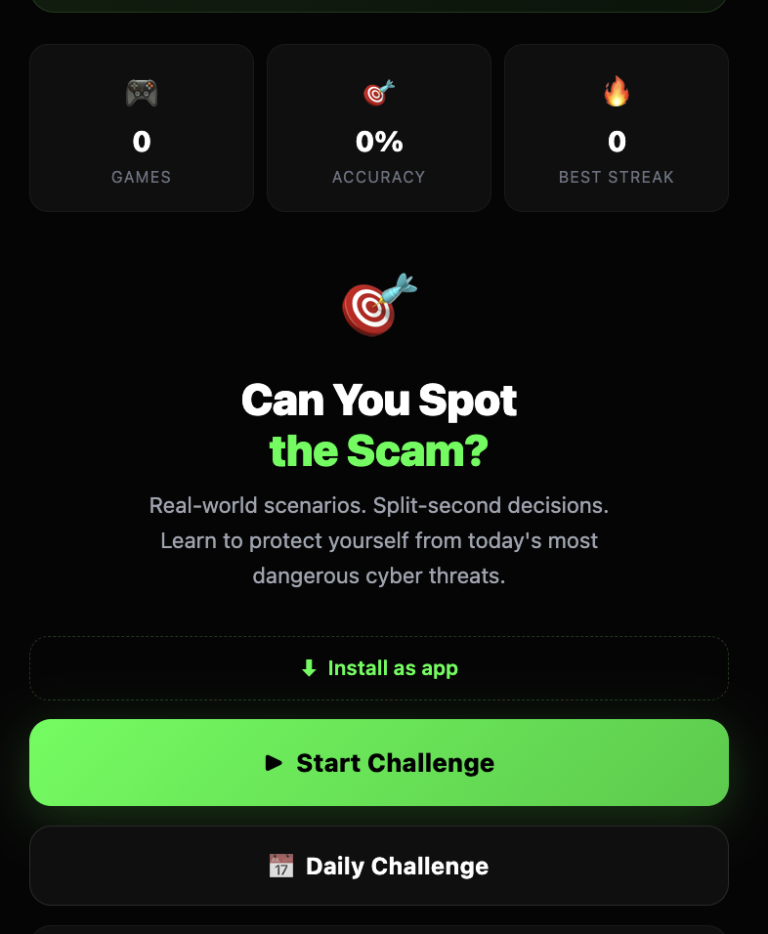
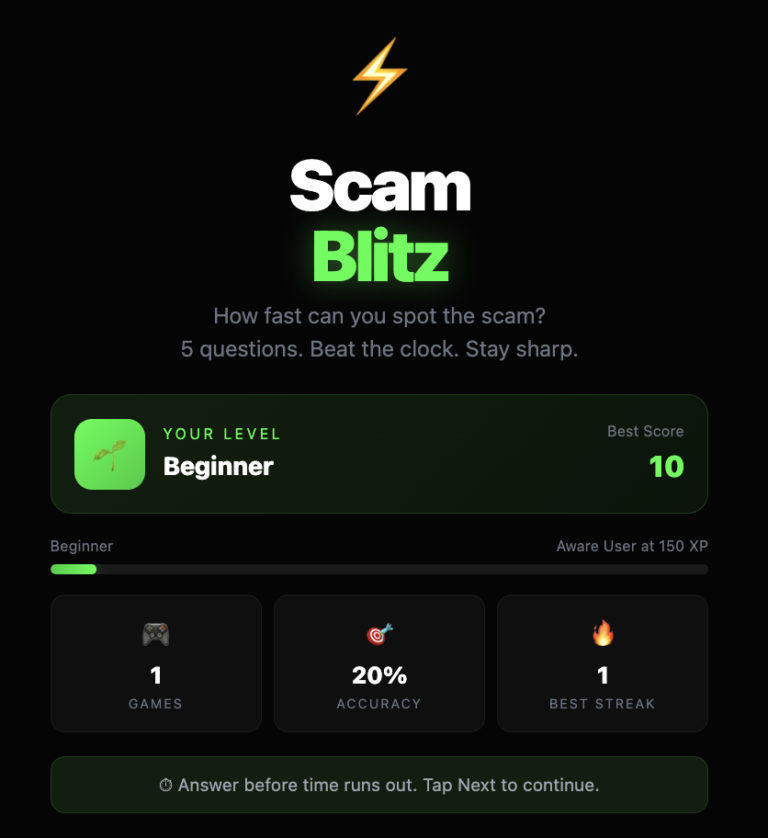
Train pattern recognition. Pattern matching is the slow brain’s superpower — but only if you’ve built the patterns. The fastest way to build them is repeated exposure to scam examples. Spend ten minutes with the Scam Detection Challenge the week before you leave. The visual and behavioral cues you encounter in the game are the same ones you’ll need to recognize at a foreign ATM or in a phishing text.
Test your digital defenses
Take the Cyber Security Trivia challenge — 10 rapid questions across passwords, phishing, Wi-Fi, malware, and more. Find out where your knowledge is solid and where it needs work.
Start the quiz →During the Trip: The Three Mental Rules
Once you’re traveling, three simple rules protect you from most decision-making failures.
Rule 1: “I will not transact while exhausted.”
If you’ve just landed off a long flight, your decision-making is impaired. Period. This is not the moment to enter banking credentials, sign up for new accounts, or respond to urgent-sounding requests. If something demands immediate financial action when you’re tired, treat that urgency as a red flag. Real banks, real airlines, and real authorities can wait 30 minutes for you to drink coffee and think clearly.
Rule 2: “I will verify on a separate channel.”
Got a call from “your bank”? Hang up. Call the number on the back of your card. Got a text from “the hotel”? Walk to the front desk. Got an email from “the airline”? Open the airline’s app and check your reservation directly. Verification on a separate channel defeats almost every social engineering attack because the attacker controls only the original channel they used to reach you.
Rule 3: “If it’s urgent and unexpected, it’s probably a scam.”
This is a hard rule that travelers can apply to almost every situation. Real life rarely produces unexpected, urgent, financial requests delivered to a phone or laptop. Scammers manufacture both at scale. When you encounter that combination, your default should be skepticism, not action.
Family-Travel Specific: Protecting Kids and Older Travelers
Awareness isn’t just personal — it’s a family-level habit. Children and older relatives are often softer targets because their pause-before-tap muscle is weaker.
For kids: Set device passcodes they don’t know to share casually. Disable in-app purchases. Have a “no installing new apps without asking” rule for the trip. Talk through one or two scenarios — “if anyone calls and says ‘I’m with mom,’ don’t share information until you call mom directly.”
For older travelers: Older adults are disproportionately targeted by scam calls and texts, often with vacation-themed pretexts (“we’re calling to confirm your hotel reservation”). Set up call screening on their phone. Walk through the “I’ll hang up and call back on the official number” rule. Add their bank’s fraud line to their phone before the trip. Our guide on the dangers of responding to unfamiliar numbers covers this in depth.
For everyone: Establish a family code word that anyone calling claiming to be a relative in trouble must say. Today’s deepfake tools can clone voices from a few seconds of audio. A code word is older than the threat, and it still works.
Frequently Asked Questions
Is it really possible to relax on vacation while staying alert?
Yes — if alertness is built into habits rather than effort. The pause-before-tap habit, verifying on a separate channel, and the “if it’s urgent and unexpected” rule cost almost no mental energy once they’re routine. The goal is not constant vigilance; it’s smart defaults that fire in the specific moments that matter.
How do I know when I’m in fast-system mode vs. slow-system mode?
You usually don’t, in real time. The signal is external: time pressure, fatigue, unfamiliarity, social pressure. When all four are present, assume your fast brain is doing the work. The fix is to artificially slow down — count to five, walk away from the screen, ask someone you trust before deciding.
Should I avoid all unfamiliar offers and conversations on vacation?
No — that would ruin the trip. The line is between curiosity (engaging with new people, trying new things, accepting friendly help) and transactions (handing over money, data, or device access). Stay open to the first; stay skeptical about the second.
What’s the single biggest awareness mistake travelers make?
Trusting urgency. Almost every successful travel scam relies on a manufactured time pressure that prevents the victim from thinking carefully. If you internalize one rule from this post, make it: “Urgency is a red flag, not a reason to comply.”
Can I rely on technology (apps, alerts, security tools) instead of awareness?
No, and yes. Technology covers a lot of the routine threats — it can flag suspicious transactions, block known phishing sites, encrypt your traffic. But the highest-value attacks are designed to bypass technology by manipulating the human. Awareness is the layer technology can’t replace.
The Bottom Line: Awareness Is the Most Portable Security Tool
You can leave the Faraday bag at home. You can forget to update your VPN subscription. You can lose track of your password manager. None of those failures matter as much as the awareness habits you carry in your head — because awareness is upstream of every other defense.
The pause before you tap. The verification on a separate channel. The instinct that urgency plus unfamiliarity equals a probable scam. These cost nothing, weigh nothing, and travel with you everywhere.
Want to keep sharpening these instincts? Try a quick round of Cyber Trivia before your next trip — the questions are designed exactly around the pattern recognition you’ll use on the road. Subscribe to the Making Sense of Security newsletter for weekly briefings on the scams travelers are seeing right now, and the awareness habits that defuse them.